Hiring on WhatsApp and Excel? 7 Signs Your Team Needs an ATS

Amaan Farhan
8 min read

A spreadsheet is enough while one person hires for one or two roles at a time and replies to everyone. You need an applicant tracking system (ATS) once CVs arrive through several channels and more than one person has a say. That is when candidates start falling into the gaps between WhatsApp, Gmail and the sheet. If three or more of the seven signs below sound like your office, it is time to switch.
You can watch this happen in public. A small recruitment agency owner on r/smallbusiness described their setup. Candidates fill in a Google Form, someone copies the details into a spreadsheet, and the rest runs on "WhatsApp, phone calls, and sometimes email". As volume grew, they lost track of "who has been contacted", "who replied" and "what stage each candidate is in" (r/smallbusiness).
It is common here too. When someone asked which software recruiters in Pakistan use, the top reply was: "Mostly are using WhatsApp / Excel sheets and then manually narrowing down applicants" (r/developersPak).
We don't have a quote from a Pakistani HR manager on this, but here is what I see. WhatsApp carries a lot more than CVs, because it is where your team talks all day. Every new message pushes the CVs further down and splits them apart, so finding the right ones when you need them means scrolling. Excel lets you see the list, and that's really it: you can't collaborate in it, upload CVs to it or rank them.
Last checked: 2 November 2026.
ATS vs spreadsheet: what each one does
A spreadsheet is a list you keep current by hand. An ATS is a shared record that fills itself in as people apply, move between stages and get messages. Neither one fixes a process your team hasn't agreed on.
Task | WhatsApp + Excel | ATS |
|---|---|---|
Where CVs arrive | Personal WhatsApp, Gmail, Rozee and LinkedIn dashboards, then copied into the sheet | Applications from every channel you post to land in one list |
Knowing a candidate's stage | A "Status" column someone must remember to update | The stage changes when you move the candidate |
Hiring manager feedback | Messages and voice notes in a WhatsApp group | Written notes on the candidate's profile |
Interview invites and replies | Sent one at a time from a phone or inbox | Sent from the tool, with the history kept on the profile |
Past applicants | Old sheets and a folder of downloaded PDFs | A searchable list of everyone who has applied |
Cost | Free | A monthly fee |
Setup | None; everyone knows Excel | Some setup: stages, the first job, inviting the team |
That "Free" cell is a real advantage. If your sheet works, keep it. The signs below tell you when it has quietly stopped working.
7 signs you have outgrown WhatsApp and Excel
1. CVs come in through four doors and you copy them into a fifth
Gmail, the HR phone, the Rozee dashboard and LinkedIn, then the sheet. Each copy-paste is a chance to skip someone. The work grows with every channel you add.
2. "Where is this candidate?" means scrolling through WhatsApp
If the true status of a candidate sits in a chat, the sheet only records the past. Your team ends up asking the one person who remembers.
3. Candidates chase you, or you go quiet without meaning to
"Any update?" messages mean some people have no clear next step. One graduate on r/hiringpakistan described clearing interviews and then getting "absolute silence" (r/hiringpakistan). From the employer's side, that silence can simply be a row nobody updated.
4. Hiring decisions happen in a WhatsApp group
The manager sends a voice note saying the second candidate was good. Three weeks later, nobody is sure which one was second. Feedback that isn't attached to the candidate gets lost.
5. Two people edit the sheet and neither trusts it
Once HR and the hiring manager both keep it, you get clashing statuses, duplicate rows and a private copy "just in case". When people check the sheet against their phones, it has stopped being the record.
6. The whole process lives on one phone
When your HR executive is on leave, or serving their notice period, the candidate chats go with them. WhatsApp lets you link up to four devices to one primary phone (WhatsApp Help). That is shared access to one person's account, not a team system.
7. You re-advertise a role when a strong runner-up applied last quarter
The second choice for your last Merchandiser opening is a good first call for the next one. If finding them means digging through old sheets and chats, you will post again and wait instead.
Is hiring on WhatsApp unprofessional?
Not by itself. Confirming an interview time or sharing a location pin on WhatsApp is fine. The trouble starts when the whole process runs on WhatsApp, because that is the pattern candidates are being warned about.
In September 2026, the Bureau of Emigration and Overseas Employment listed "recruitment conducted only through WhatsApp, Telegram or social media" among the warning signs of fake overseas job offers (Daily Pakistan).
Pakistan's National CERT told job seekers to "be cautious of unsolicited job offers on WhatsApp or Telegram" and to avoid offers that "skip formal hiring steps" (PK CERT advisory, July 2025).
FIA and BEOE officials advised people to check carefully before sending CNIC copies or passport details online (APP, May 2026).
These warnings are about scams, not about you. A candidate, though, can't tell the difference between you and a scammer when an unknown number asks for their CV and CNIC on WhatsApp. A job post under your company name, a proper application link and email from a company address show them who you are.
So keep WhatsApp for quick check-ins once the candidate knows who you are. Ask for CNIC copies at the offer stage, not with the application.
Self-check: is it time to switch?
Think about your last month of hiring. Tick each line that was true:
Applications reached us through three or more channels.
At least once, we couldn't tell a candidate's stage without checking a chat.
A candidate followed up because we hadn't told them anything.
Hiring manager feedback came by WhatsApp or voice note, not written next to the candidate.
More than one person edits our tracking sheet.
Candidate conversations sit on one person's phone.
We re-posted a role without first checking past applicants.
We had more than two roles open at the same time.
Ticks | What to do |
|---|---|
0 to 2 | Keep the sheet. Tighten it with the template in the next section. |
3 to 5 | Try an ATS on one live role and compare. |
6 to 8 | The sheet is costing you candidates. Move your next role to an ATS. |
These cut-offs are our own rule of thumb, not an industry standard. Vendors don't agree either: one suggests an ATS once you hire 15 to 20 people a year (New Network), another says 25 to 40 (Recruitee). Your number of open roles and decision-makers matters more than a yearly total.
When you don't need an ATS yet
You can stay on a spreadsheet if one person runs hiring, you have one or two openings at a time, and the hiring manager reads the sheet. Even ATS vendors say this: a sheet works when it has one owner and few moving parts (CapoFine, 100Hires).
If that is you, make the sheet do more of the work. These are the columns we would use for a Pakistani team:
Column | Why it's there |
|---|---|
Name, phone, email | One row per person, so you can reach them without searching chats |
Role | One sheet for all roles, filtered by this column |
Source (Rozee, LinkedIn, Indeed, referral, walk-in) | Shows which channel is worth paying for next time |
City, and willing to relocate? | Saves an interview with someone who can't come to site |
Current and expected salary (PKR) | Avoids a surprise at the offer stage |
Notice period | Tells you the real joining date |
Stage (dropdown: Applied, Shortlisted, Interview, Offer, Hired, Rejected) | A dropdown stops "maybe", "on hold" and "call later" from creeping in |
Next step and date | The column that prevents accidental ghosting |
Owner | One name per row, so someone is responsible |
Last contact date | Sort by it to find people waiting too long |
Feedback (written) | Ask managers to type two lines here, not send a voice note |
Four house rules keep it honest:
One sheet, with one person who owns its structure.
Every active row has a next step and a date.
Rejected candidates get a message the same week.
CVs go into one shared folder named by role, not into someone's Downloads.
For the screening itself, this method for shortlisting 200 CVs in an afternoon fits this sheet as it is.
Moving from a sheet to an ATS without losing anyone
You don't need to move your whole history on day one. This order keeps the switch small:
Start with one live role. Pick the next opening, not the backlog.
Copy your stages. Use the same stages as your sheet's dropdown, so nobody has to relearn the process.
Post the new role from the ATS. Every applicant then lands there from day one, wherever they found the job.
Finish old roles in the sheet. Two records of the same candidate is worse than either one.
Bring over the people you will call again. Shortlisted candidates and strong runners-up from recent roles. Archive the rest.
Give the hiring manager their own login. Ask for feedback as a note on the profile, not in the WhatsApp group.
Agree one rule. If it isn't in the ATS, it didn't happen.
Re-run the self-check after a month. If the ticks don't drop, the problem is the process, not the tool.
Where Taraki fits, and where it doesn't
Taraki is our product, and this is the exact problem we built it for. Read this section knowing that.
Post a job on Taraki and it appears on your company's LinkedIn page, then also goes out to Google Jobs and Indeed (job distribution). Applicants from all of those sites end up in a single applicant tracking pipeline. AI scoring rates each applicant against the role, so the list opens with the strongest first. That covers signs 1 and 2.
For signs 4 and 5, collaborative hiring lets you tag a teammate on a candidate's profile and leave a note there for anyone to read later. There are no per-seat fees. One account covers unlimited team members, so the hiring manager gets their own login instead of forwarded CVs.
You send candidate emails through Gmail and book Google Meet interviews from inside Taraki, which helps with sign 3. Past applicants stay in a candidate database you can search before posting again (sign 7).
Taraki charges a single flat fee each month, with no hidden extras. Silver covers three job posts each month; Gold has no job limit. Current plans are on the pricing page.
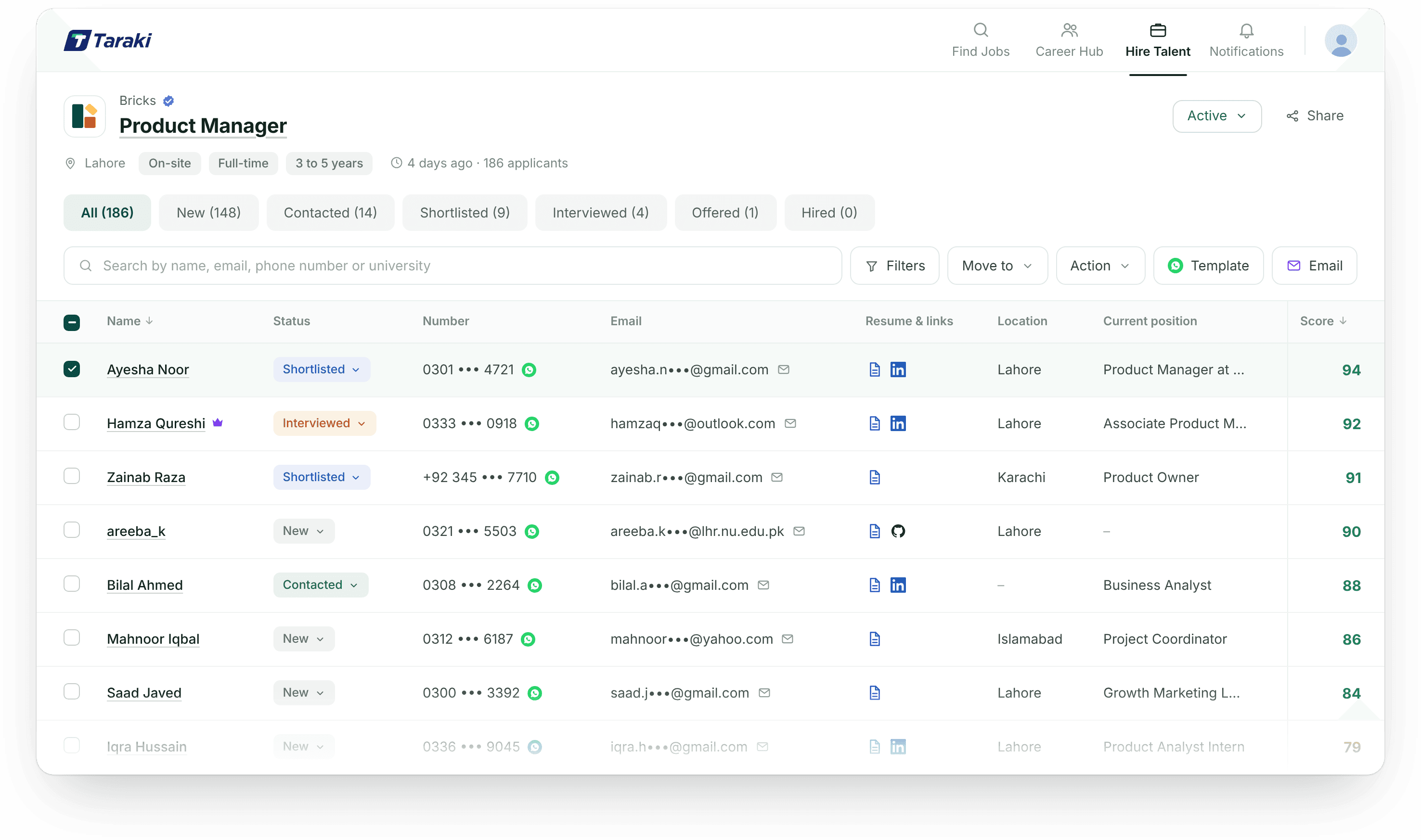
A Product Manager role in Lahore inside Taraki: applicants from every source in one list, ranked by score, each with a stage.
What Taraki doesn't do:
Rozee and Mustakbil aren't on its posting list. If a local board brings you good applicants, keep using it alongside.
It doesn't make the hiring decision. The score tells you who to read first, not who to hire.
If you hire a couple of people a year, the sheet above is honestly enough.
Comparing tools? Best recruitment software in Pakistan sets Taraki beside Manatal, Workable, Zoho Recruit, PayPeople and Resourceinn. Still choosing job boards? Here is how Rozee, Mustakbil, LinkedIn and Indeed compare for employers.
Frequently asked questions
Can Google Sheets work as an applicant tracking system?
For a handful of roles with one owner, yes. Use dropdowns for stages and a next-step date on every row. It won't collect applications from job boards or keep messages with the candidate, so it gets harder as volume grows.
How many hires a year before a company needs an ATS?
There is no official number. Vendors suggest anywhere from 15 to 40 hires a year. For a Pakistani SME, the better test is how many roles are open at once and how many people decide.
Is it okay to collect CVs on WhatsApp?
It works for a few referrals, but CVs on one phone are hard to share, search or hand over. A proper application link also reassures candidates who have been warned about WhatsApp-only job scams.
What should we move into the ATS first?
Your next live role, plus shortlisted candidates and runners-up from recent roles. Leave the old sheet as an archive rather than re-typing it.
Will an ATS stop us using WhatsApp with candidates?
No. You can still message candidates on WhatsApp for quick check-ins. The difference is that the stage, feedback and CV live in the ATS, so the chat isn't the only record.
Want every applicant, note and interview for a role in one place your whole team can see? See how Taraki's applicant tracking works.
Amaan Farhan, Marketing Associate at Taraki
Amaan Farhan is a Marketing Associate at Taraki, where he leads marketing and growth with an AI-native approach. He writes about how Pakistani teams can hire with less admin and better tools. LinkedIn
Table of contents
Read More Blogs